
Introduction: The Global Demand for Reliable Clothing Manufacturers
In today's fast-moving fashion market, choosing the right clothing manufacturer is no longer just about price—it's about quality, speed, flexibility, and long-term scalability. As global brands race to meet consumer demand, the spotlight remains firmly on China, which continues to dominate the apparel supply chain.
Despite rising competition from Southeast Asia, China's clothing manufacturing ecosystem is still unmatched in terms of efficiency, infrastructure, and innovation. For startups and established brands alike, working with the right clothing manufacturer can define success or failure in a highly competitive market.
China: The World’s Leading Clothing Manufacturing Hub
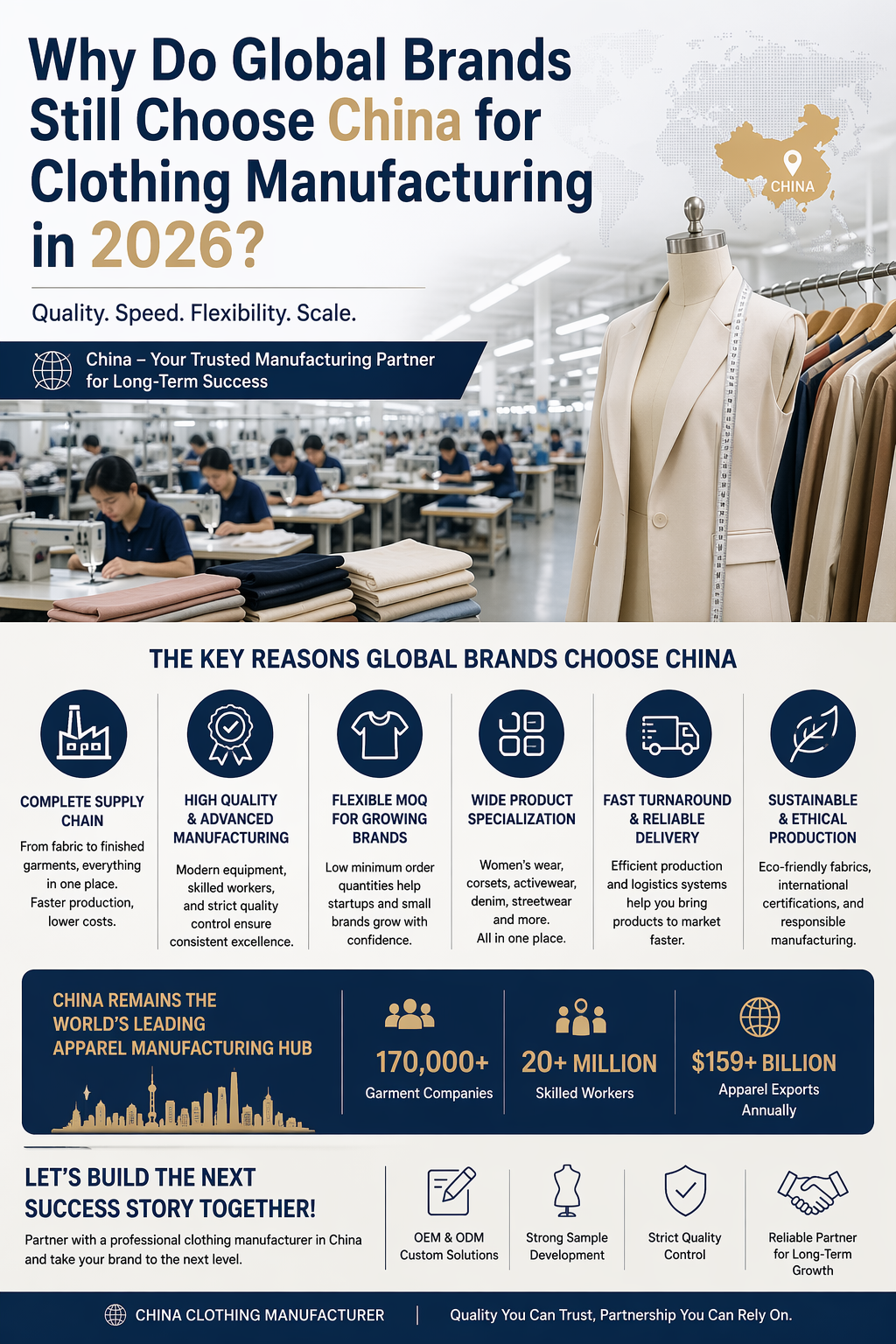
1. Complete Supply Chain Integration
One of China’s biggest strengths is its fully integrated supply chain. From fabric sourcing to dyeing, cutting, sewing, and packaging, everything can be completed within a single region.
This reduces:
▶ Lead times
▶ Communication gaps
▶ Production costs
For brands, this means faster product launches and fewer delays.
Key Advantages of Working with a Clothing Manufacturer in China
1. Complete Supply Chain Integration
One of China’s biggest strengths is its fully integrated supply chain. From fabric sourcing to dyeing, cutting, sewing, and packaging, everything can be completed within a single region.
This reduces:
▶ Lead times
▶ Communication gaps
▶ Production costs
For brands, this means faster product launches and fewer delays.
2. High Quality and Advanced Manufacturing
One of China’s biggest strengths is its fully integrated supply chain. From fabric sourcing to dyeing, cutting, sewing, and packaging, everything can be completed within a single region.
This reduces:
▶ Lead times
▶ Communication gaps
▶ Production costs
For brands, this means faster product launches and fewer delays.
3. Flexible MOQ for Growing Brands
A major shift in recent years is the move toward low minimum order quantities (MOQ) and flexible production.
This is a game-changer for:
▶ Startup fashion brands
▶ DTC (direct-to-consumer) businesses
▶ Small batch designers
Instead of committing to thousands of units, brands can now test the market with smaller runs.
4. Wide Product Specialization
China’s clothing manufacturers cover virtually every category:
▶ Women’s fashion & dresses
▶ Corsets and lingerie
▶ Activewear and sportswear
▶ Denim and streetwear
▶ High-end tailored garments
This diversity allows brands to scale across multiple product lines with one manufacturing base.
Industry Trends Shaping Clothing Manufacturers in 2026
1. Shift Toward Technology-Driven Production
The industry is moving away from labor-intensive production toward automation and smart manufacturing.
Examples include:
▶ AI-assisted design
▶ Automated cutting machines
▶ Digital sampling
This improves both efficiency and precision.
2. Sustainability and Ethical Production
Global consumers are demanding more transparency. As a result, clothing manufacturers are adopting:
▶ Eco-friendly fabrics (organic cotton, recycled fibers)
▶ Certifications like OEKO-TEX and GOTS
▶ Energy-efficient production systems
Sustainability is no longer optional—it’s a competitive advantage.
3. Fast Fashion Meets Small-Batch Production
The rise of brands using “small order, fast response” models has reshaped manufacturing.
Instead of mass-producing inventory, brands now:
▶ Launch smaller collections
▶ Test trends quickly
▶ Reorder based on demand
This requires manufacturers to be agile, responsive, and highly organized.
How to Choose the Right Clothing Manufacturer
Not all manufacturers are equal. When selecting a clothing manufacturer, focus on:
1. Sampling Quality
A professional factory should deliver samples that match:
▶ Tech packs
▶Fabric specifications
▶Fit accuracy
2. Communication Efficiency
Clear communication reduces costly mistakes. Look for teams that:
▶Understand technical requirements
▶Respond quickly
▶Offer solutions, not excuses
3. Production Capability
Check:
▶Monthly capacity
▶Equipment and technology
▶Experience with your product category
4. Quality Control System
Reliable manufacturers implement:
▶Inline inspections
▶Final QC checks
▶Consistent production standards
Challenges in the Clothing Manufacturing Industry
While China remains dominant, there are challenges brands should be aware of:
Rising labor costs
▶Increasing global competition
▶Sustainability pressures
▶Supply chain disruptions
However, thanks to its mature ecosystem and infrastructure, China continues to outperform many alternatives in terms of quality + speed + reliability.
Why the Right Clothing Manufacturer Matters More Than Ever
In 2026, the fashion industry is no longer just about design—it’s about execution.
A strong clothing manufacturer can help you:
▶Reduce production risks
▶Improve product quality
▶Speed up time-to-market
▶Scale your brand efficiently
On the flip side, the wrong partner can lead to delays, inconsistent quality, and lost revenue.
Why the Right Clothing Manufacturer Matters More Than Ever
At the end of the day, success in fashion comes down to choosing the right manufacturing partner.
We are a professional clothing manufacturer based in China, with:
▶Years of experience in women’s fashion, corsets, and structured garments
▶Strong sample development capabilities
▶Flexible MOQ for startups
▶Strict quality control and skilled craftsmanship
Whether you are launching your first collection or scaling an established brand, we focus on delivering high-quality garments with reliable production timelines.
Post time: Apr-22-2026